
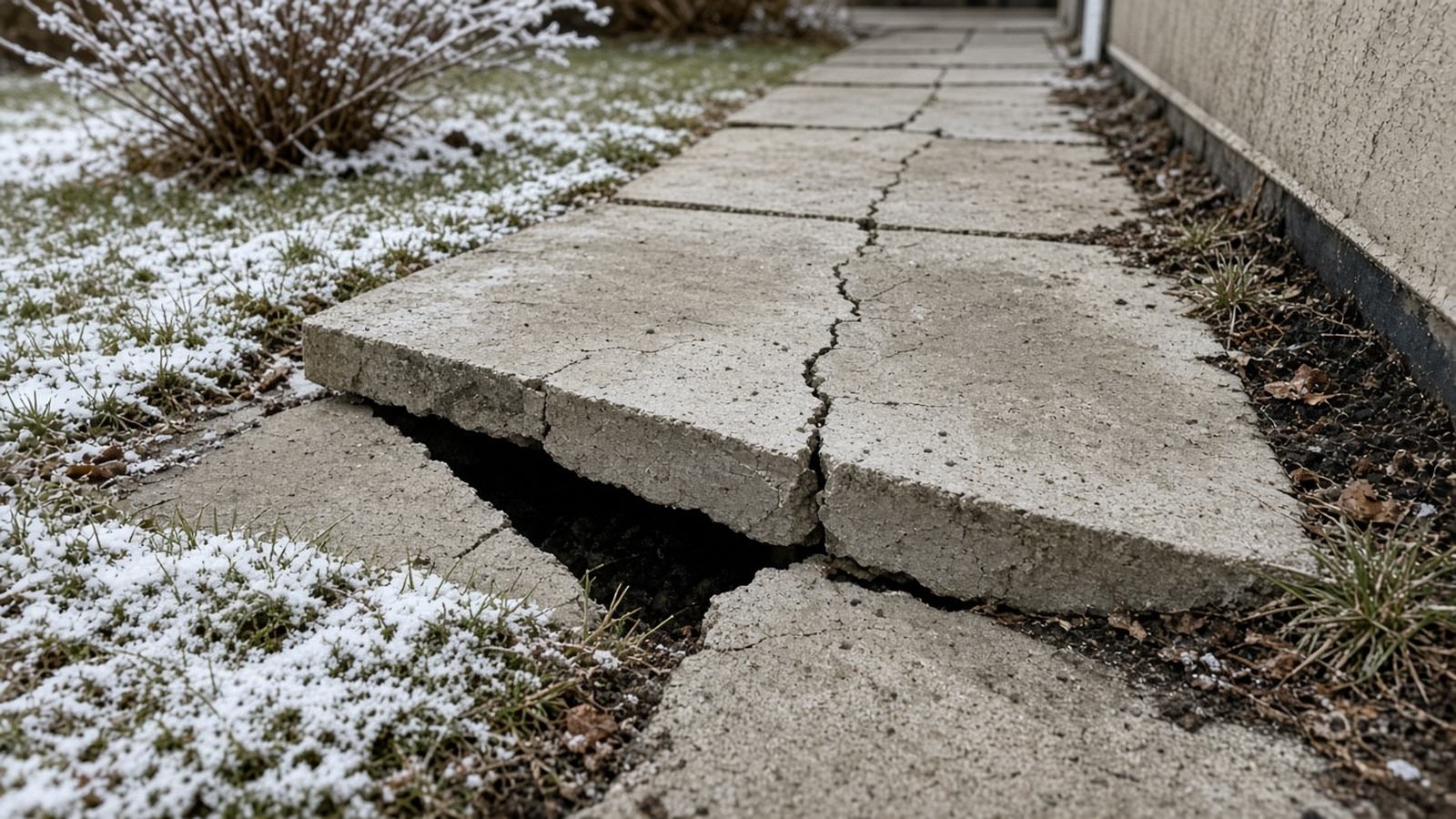
Come April, the ground hands out its winter report card. Cracked driveways. Front steps pulled an inch off the house. A garage slab with a new tilt. Manhole lids standing proud just in time for the last plow run. Most of that is frost heave. And no, it’s not simply water swelling as it turns to ice. Layers of ice grow in the soil and jack things up, rarely evenly. We can’t stop Canadian ground from freezing. What a coating can do is cut off some of the water frost heave depends on. Here’s how heave works, how to size up your soil, what it does to concrete and what actually stops it.
How frost heave works
Canada’s National Research Council described the process in its Canadian Building Digest on ground freezing and frost heaving (CBD-26, E. Penner, 1962). Old thinking blamed expansion of freezing water. The digest corrects that: growing ice crystals pull water in from the soil around them and build ice lenses.
Here’s the sequence:
- In fall, the ground surface freezes, and the freezing plane slowly moves down into the soil.
- In damp, fine soil, that freezing front behaves like a dry patch, and water from the unfrozen soil underneath wicks up to it.
- That water joins the ice crystals and grows a lens of nearly pure ice.
- The lens lifts the soil, and whatever sits on it.
The vertical movement is far larger than the expansion of freezing water alone. The digest says movements of 4 to 8 inches aren’t unusual, and as much as 24 inches has been reported. Heaving pressures over 14 psi have been measured in the field, and a lab test produced 213 psi in a clay soil. That’s far more than the load under a road or most building footings, which is why frost lifts them so easily.
The three things frost heave needs
Both the NRC digest and Pavement Interactive’s reference on frost action list the same three requirements:
| Requirement | What it means | Can you control it? |
|---|---|---|
| Freezing temperatures in the soil | The freezing plane has to reach the soil | Sometimes, with insulation or heat loss from a building |
| Frost-susceptible soil | Fine-grained soil that lets water move up to the ice | Yes, by replacing it with clean, coarse granular fill |
| A supply of water | Groundwater, infiltration or water held in the soil | Partly, with drainage and by keeping surface water out |
Remove any one of the three and frost heave stops or drops sharply. The NRC digest notes that controlling soil temperature is seldom economical, so the usual fix is replacing fine soil with coarse granular material and controlling water with drainage.
Which soils heave
The NRC digest puts it plainly. Coarse sands and clean gravels don’t heave. Fine sands and silts are very susceptible. Clays heave too, usually more slowly but often with huge pressures. Silts heave fast with lower pressures. And sands or gravels contaminated with clay heave more, and less predictably.
Pavement Interactive adds the numbers engineers use. Many agencies treat a soil as frost-susceptible if 10% or more passes a No. 200 (0.075 mm) sieve, or 3% or more passes a 0.02 mm sieve. Arthur Casagrande’s 1932 rule of thumb says to expect considerable ice segregation in non-uniform soils with more than 3% of grains smaller than 0.02 mm, and in very uniform soils with more than 10%. He saw no ice segregation in soils with less than 1% finer than 0.02 mm, even with groundwater as high as the frost line.
Frost heave risk checker
If you have a soil report with a grain-size analysis, use it here. If not, answer what you can. This is a screening tool, not a geotechnical assessment.
Frost heave risk checker
The soil thresholds come from the Casagrande criterion as summarized by Pavement Interactive. The scoring is our own simplification for screening.
How frost heave damages concrete
Uniform heave is often harmless. The NRC digest notes that a detached unheated building can rise evenly with no distress. The trouble is differential heave, when one part rises more than another. Pavement Interactive lists where it’s most likely: transitions from clean sand to silty soil, cut-to-fill transitions with shallow groundwater, and around drains and culverts, where backfill differs and buried pipes change the soil temperature.
What that looks like on a property:
- Slabs and driveways crack and tilt. When the ice melts, the soil underneath can be weak and settle unevenly. If you’re dealing with that, this guide to a sinking concrete slab explains the repair options.
- Steps and stoops lift away from the house, because the house is heated and the steps aren’t.
- Foundation walls can be lifted by soil freezing to them. The NRC digest warns that frost heaving in backfill can lift a foundation wall because the soil adheres to it. Saturated soil and frost pressure also push basement walls inward. This breakdown of bowing basement wall repair cost covers what that repair involves.
- Manholes and utility castings get lifted by the pavement around them and then hit by plows. This piece on manhole adjustment rings covers how crews reset them. Our own look at manhole linings in Canada covers protecting the structure itself.
Preventing frost heave
The NRC digest’s recommendations still hold up:
- Footings below frost. For unheated buildings and additions, put footings below the maximum frost depth, with carefully selected, well-drained backfill.
- Granular mats under slabs. For a slab on grade, a mat of coarse granular material acts as a buffer. The digest says 12 to 18 inches is usually adequate.
- Retaining walls. Backfill with clean granular fill and add weep holes at the bottom of the exposed wall.
- Driveways. Keep the subgrade uniform, and the digest suggests adding 6 inches of clean granular fill for support during spring thaw.
- Drainage. Direct roof runoff away from critical areas with grading and landscaping.
The digest also notes that drainage alone usually can’t dry soil enough to stop heaving entirely. It reduces it. Where movement can’t be tolerated, replacing the soil is the usual answer.
Where coatings help with frost heave
Coatings work on the water side of the problem. They can’t stop groundwater rising from below, but they can keep surface water from getting into the places where it feeds frost and freeze-thaw damage:
- Sealing slab cracks and joints so meltwater and rain don’t run straight into the subgrade. Pavement Interactive notes that surface water enters mainly through cracks and joints.
- Waterproofing foundation walls so the concrete itself doesn’t absorb water and spall with freeze-thaw cycles.
- Protecting concrete surfaces such as steps, curbs and ramps from water and de-icing salts. See concrete rehabilitation with polyurea.
- Lining manholes, cisterns and vaults so water doesn’t move through the structure. See our post on polyurea cisterns.
Be honest with clients about the limits. If the soil is frost-susceptible and wet, a coating on top won’t stop the ground from heaving. It’s one part of a fix that starts with drainage and soil.
For applicators, timing is the other challenge. Most of this work happens in shoulder seasons, and our guide to spraying polyurea in cold weather covers what changes when it’s cold.
Frost heave prevention checklist
☐ Soil type known
Grain-size results, or at least a description from a test pit.
☐ Footings below frost
For unheated structures and additions.
☐ Granular fill used
Under slabs, behind walls and at driveway subgrades.
☐ Drainage working
Grading away, downspouts extended, weep holes clear.
☐ Cracks and joints sealed
Surface water kept out of the subgrade.
☐ Foundation walls protected
Waterproofed and backfilled with draining material.
☐ Transitions checked
Where soil, backfill or utilities change.
Frost heave FAQ
What causes frost heave?
Ice lenses growing in fine-grained, moist soil. As the ground freezes, water moves up to the freezing plane and adds to the ice, which lifts the soil and anything on it.
How much can frost heave lift?
The NRC digest says vertical movements of 4 to 8 inches aren’t unusual, and up to 24 inches has been reported.
Which soils are most prone to frost heave?
Fine sands, silts and clays. Clean gravels and coarse sands don’t heave. Sands and gravels mixed with clay heave more and less predictably.
Can sealing my driveway stop frost heave?
Sealing cracks and joints helps by keeping surface water out of the subgrade, but it won’t stop heave if the soil is frost-susceptible and groundwater is high. Drainage and soil replacement do more.
Why do steps lift but not the house?
A heated house keeps the soil near its foundation from freezing, and its footings sit below frost. Unheated steps or stoops on shallow footings get the full force of the frost.