
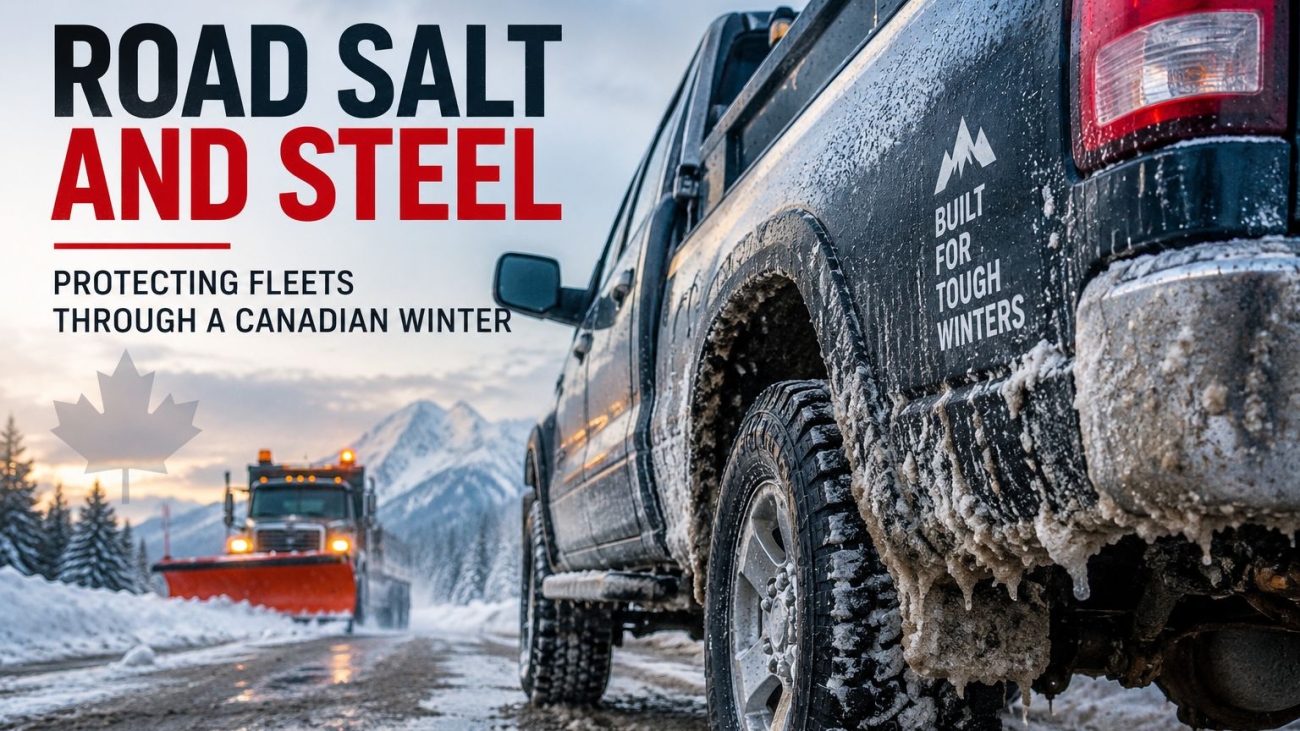
Every Canadian winter runs the same experiment on fleet vehicles, whether anyone thinks of it that way or not. Road salt goes down to keep highways passable, and steel goes to work driving through it, day after day, for months. By spring, the vehicles that weren’t protected show it, sometimes in ways that go well beyond cosmetic rust and straight into structural repair costs and shortened service life.
This guide looks at how road salt actually corrodes steel, where fleet vehicles take the worst of that damage, and what coating options genuinely hold up against a Canadian winter rather than just delaying the inevitable by a season or two, so fleet managers can plan protection around actual duty cycles instead of a generic maintenance calendar.
Understanding the Basics
Road salt, typically sodium chloride or calcium chloride, works by lowering the freezing point of water on road surfaces, which is exactly why it’s effective at preventing ice buildup. That same chemical property is what makes it so damaging to steel. Chloride ions are highly effective at breaking down the protective oxide layer that would otherwise slow corrosion on bare or painted steel, and they accelerate the electrochemical reaction that turns iron into rust far faster than plain moisture alone would.
This isn’t a slow, uniform process either. Salt-laden slush gets thrown up onto the underside of a vehicle, collects in seams, wheel wells, and frame cavities, and then sits there through repeated freeze-thaw cycles, keeping those areas wet and salt-exposed far longer than the vehicle’s exterior, which at least dries off between drives and gets washed periodically.
Where Fleet Vehicles Take the Worst of It
A handful of areas consistently take the brunt of road salt damage, and they’re mostly out of sight during a routine visual inspection, which is part of why the damage often isn’t caught until it’s already significant.
The undercarriage and frame rails see direct, sustained exposure to salt spray thrown up by the vehicle’s own tires and the tires of vehicles ahead of it. Frame rails are structural, which makes corrosion here more consequential than surface rust on a body panel.
Wheel wells trap salt-laden debris in a confined space with limited airflow, creating a persistently damp, salt-concentrated environment that’s one of the more common starting points for visible rust.
Brake lines, fuel lines, and other exposed metal components running along the underside of the vehicle are vulnerable in a way that’s less obvious until a line actually fails, since corrosion damage to a line isn’t something a driver notices until it’s already a problem.
For municipal and service fleets specifically, plow attachments, mounting hardware, and hydraulic components see even more concentrated exposure than the vehicle itself, since they’re often in direct, repeated contact with salted and sanded road surfaces throughout the winter season.
Why Fleet Vehicles Are Especially Vulnerable
Personal vehicles that see occasional winter driving get a break between exposures, time to dry out, time between storms, sometimes indoor parking overnight. Fleet vehicles, particularly municipal plow trucks, service vehicles, and delivery fleets, often don’t get that break. They’re in near-continuous use throughout the winter season, accumulating salt exposure day after day with minimal recovery time in between.
That cumulative exposure is the real driver behind why fleet vehicles tend to show corrosion damage faster and more severely than personal vehicles of a similar age, and it’s exactly why fleet-specific protection planning matters more than treating winter protection as an afterthought.
Coating Options for Fleet Protection
Traditional oil-based or wax-based undercoating has been a long-standing option, applied as a spray-on film that displaces moisture and provides a barrier against salt exposure. It’s relatively inexpensive but requires reapplication on a regular schedule, since the coating wears and washes away over time and doesn’t bond permanently to the substrate.
Rubberized undercoating offers a thicker, more durable barrier than oil-based products, with better resistance to abrasion from road debris. It still isn’t a permanent solution and needs periodic inspection and touch-up, particularly at high-wear points.
Spray-applied polyurea or polyurethane coatings bond directly to the substrate and cure into a seamless, flexible film that doesn’t wash off or require seasonal reapplication the way traditional undercoating does. The flexibility of these coatings matters specifically for fleet vehicles, since it allows the coating to move with the metal through vibration, temperature swings, and road impact without cracking, which is exactly the kind of stress a working fleet vehicle experiences far more than a passenger car.
Galvanization, zinc coating applied during manufacturing, offers strong long-term corrosion resistance but isn’t something that can be retrofitted onto an existing vehicle’s frame or components. It’s a consideration at the vehicle procurement stage rather than an ongoing fleet maintenance option.
Undercoating Options Compared
| Option | Durability | Reapplication Needed | Best For |
|---|---|---|---|
| Oil/wax-based undercoating | Lower | Annual or more frequent | Budget-conscious, lower-mileage vehicles |
| Rubberized undercoating | Moderate | Periodic touch-up | General fleet use, moderate exposure |
| Spray-applied polyurea/polyurethane | High | Rarely, bonded coating | High-mileage, continuous-use fleet vehicles |
| Galvanization | High | Not applicable, built-in | New vehicle procurement, not retrofit |
Timing and Application Considerations for Fleet Operators
Getting protective coating applied before winter conditions set in matters more than most fleet managers plan for, since a vehicle that’s already accumulated a season of salt exposure and hidden corrosion is starting from a worse position than one coated before its first exposure. For fleets operating on a tight schedule, coordinating coating application during a lower-demand period, rather than scrambling once winter has already started, reduces the operational disruption of pulling vehicles out of service.
Application conditions matter too, particularly for spray-applied coatings that depend on proper substrate temperature and moisture conditions to bond correctly. Our guide on substrate temperature and dew point for cold-weather application covers exactly this consideration, and it applies directly to fleet undercoating projects scheduled during the shoulder season before winter fully sets in.
Inspection and Maintenance Through the Season
Even a well-coated fleet vehicle benefits from periodic inspection through the winter months, since damage from road debris, curb strikes, or general wear can compromise a coating’s protection at specific points even when the coating overall is holding up well. Catching a small area of exposed metal early and addressing it with a spot repair is far less costly than discovering a fully developed rust problem in the spring.
Fleet managers running larger operations often build coating inspection into existing seasonal maintenance schedules rather than treating it as a separate task, which tends to produce better long-term compliance than a standalone inspection program that competes for attention with other maintenance priorities. Pairing coating inspection with routine service intervals, oil changes, brake checks, seasonal tire swaps, means the vehicle is already in the shop and accessible, which removes one of the more common reasons inspection gets deferred or skipped entirely.
Things to Consider Before Coating a Fleet
- What’s the vehicle’s actual duty cycle, continuous winter use versus occasional exposure, and does that favor a more durable, bonded coating over traditional undercoating?
- Has coating been scheduled before winter conditions begin, or is it being addressed reactively after damage is already visible?
- Are high-exposure components like plow mounts and hydraulic hardware being addressed specifically, not just the general vehicle undercarriage?
- Is there a documented inspection routine through the winter season to catch coating damage before it becomes a larger corrosion problem?
- Does the coating choice account for the specific application conditions, temperature and moisture, at the time of application?
Beyond individual fleet vehicles, the same underlying corrosion mechanism affects fixed infrastructure exposed to road salt and winter conditions across the country. Our piece on climate pressure on Canadian infrastructure covers how this broader trend is affecting protection decisions well beyond fleet vehicles specifically.
The Bigger Picture: Protecting What Keeps Communities Running
Fleet vehicles, particularly for municipalities, aren’t just assets on a balance sheet, they’re the vehicles keeping roads clear, water systems running, and services operating through the exact winter conditions that are hardest on steel. Premature fleet replacement due to corrosion damage is an expensive, avoidable outcome, and it’s part of a broader pattern of winter infrastructure strain that’s becoming more visible across the country. Our overview of polyurea coatings in Canada covers how this same coating approach applies across a wider range of Canadian applications facing similar winter conditions.
Frequently Asked Questions
How much faster does road salt corrode steel compared to plain moisture?
Chloride ions significantly accelerate the electrochemical corrosion process compared to moisture alone, which is why vehicles in regions with heavy road salt use tend to show corrosion damage considerably faster than those in regions without it.
How often does traditional undercoating need to be reapplied?
It varies by product and exposure level, but oil or wax-based undercoating typically needs annual or more frequent reapplication, since it wears away and doesn’t bond permanently to the substrate the way a spray-applied coating does.
Is spray-applied coating worth the higher upfront cost for fleet vehicles?
For high-mileage, continuous-use fleet vehicles facing repeated winter exposure, the durability and reduced reapplication needs of a bonded coating often offset the higher upfront cost over the vehicle’s service life, particularly compared to the cost of premature corrosion-related repairs or replacement.
Can existing corrosion damage be coated over, or does it need to be repaired first?
Existing rust and corrosion should be properly treated and, where needed, repaired before a new protective coating is applied, since coating over active corrosion doesn’t stop the underlying process and can trap moisture against already-damaged metal.
Do plow attachments need separate protection from the vehicle itself?
Yes. Plow mounts, hydraulic components, and attachment hardware see some of the most concentrated exposure on a service vehicle and often benefit from being addressed specifically rather than assumed to be covered by general vehicle undercoating.
Conclusion
Road salt does exactly what it’s designed to do on the road surface, and exactly what nobody wants it to do to the steel driving over it. Fleet vehicles take that damage harder and faster than occasional-use vehicles simply because of how much winter exposure they accumulate without a break. Choosing a protection approach that matches the vehicle’s actual duty cycle, timing that protection before the season starts rather than after damage appears, and keeping up with inspection through the winter months is what separates a fleet that ages gracefully from one that’s fighting rust-related repairs and early replacement year after year.