
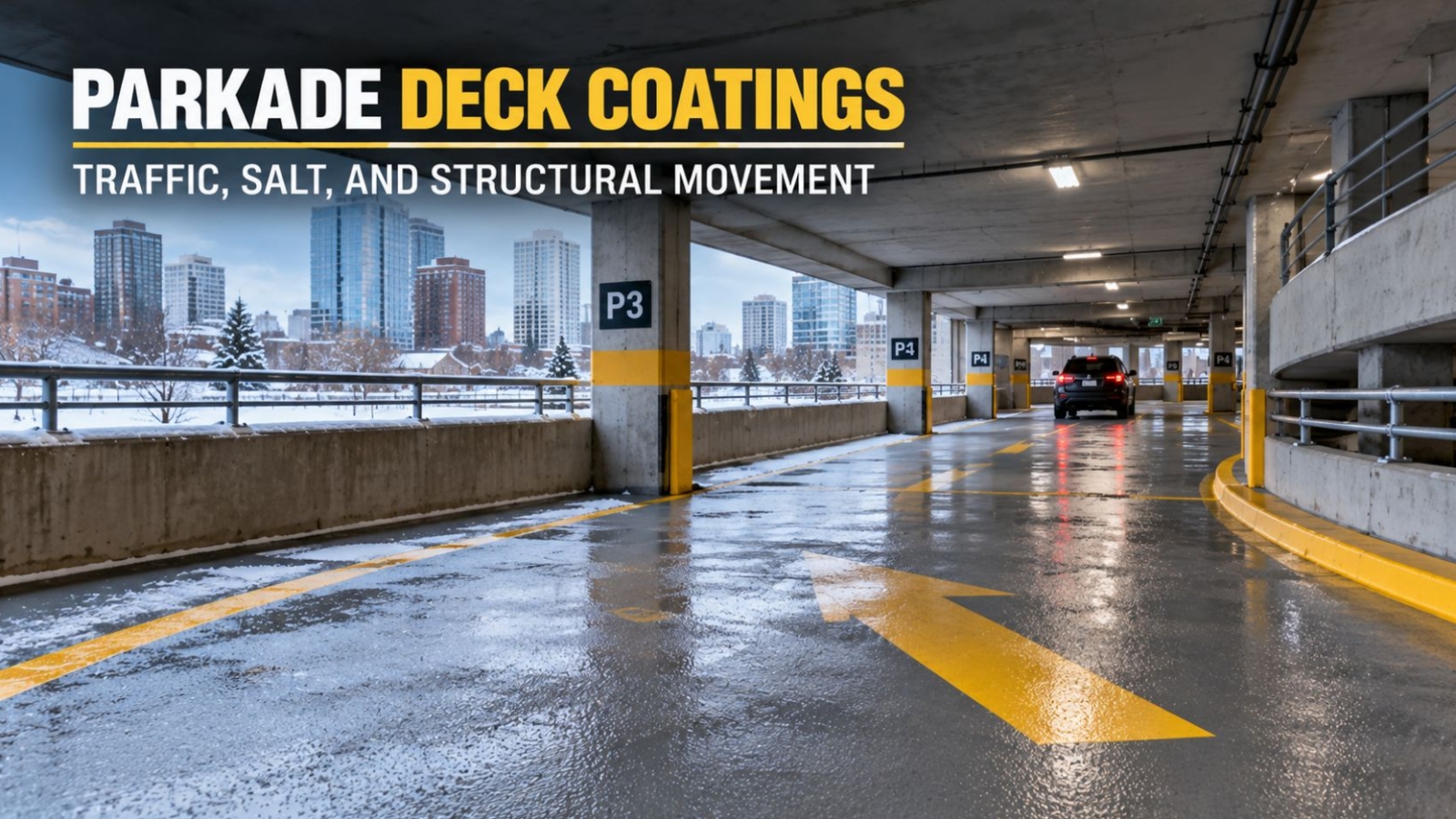
A parkade deck in Canada takes a beating that most concrete structures never have to deal with, and it takes that beating from three directions at once. Vehicle traffic grinds and scrapes at the surface every single day. Road salt, tracked in on tires and undercarriages all winter long, works its way into the concrete and goes after the reinforcing steel underneath. And the deck itself is constantly moving, expanding and contracting with temperature swings, flexing under vehicle load, in ways that a static wall or floor never experiences. Parkade deck coating exists specifically to manage all three of these stresses at once, and treating a parkade like it just needs a tough floor coating misses two-thirds of the actual problem.
This guide covers why parkade decks fail the way they do, what a proper coating system actually has to handle, and where expansion joints and structural movement fit into a project that’s easy to underestimate if you’ve only ever coated a static floor before and assume the same approach will transfer over cleanly.
Why Parkade Decks Are a Different Kind of Problem
Start with traffic. Tires, especially under braking, turning, and stop-and-go movement typical of parking structure circulation, create real abrasive wear on a deck surface, concentrated disproportionately at ramps, turns, and entry points rather than spread evenly across the whole structure. A coating that performs fine on a lightly trafficked warehouse floor can wear through surprisingly fast at a parkade’s high-turn zones.
Then there’s salt, and this is where parkade deck coating becomes a genuinely higher-stakes problem than most people realize. Vehicles track in road salt and de-icing chemicals throughout the entire winter, and that chloride-laden slush drips and pools on the deck surface. Left unprotected, chloride ions penetrate the concrete and reach the embedded reinforcing steel, triggering corrosion that expands as it progresses, cracking and spalling the concrete from the inside out. This isn’t a cosmetic problem, it’s a structural one, and it’s the single biggest reason aging, uncoated or poorly coated parkade decks across the country need expensive structural rehabilitation well before their designed service life is up.
Structural movement rounds out the trio. A parkade deck expands and contracts with temperature, deflects under vehicle load, and often incorporates expansion joints specifically designed to accommodate that movement between structural sections. A coating applied without accounting for this movement, particularly a rigid, inflexible system, will crack at exactly the points where the structure is designed to move, opening a direct path for water and chloride intrusion right where the deck needs protection most.
What a Parkade Deck Coating System Actually Needs to Do
Given all three of those stresses happening simultaneously, a parkade deck coating needs to be abrasion resistant enough to handle sustained vehicle traffic without wearing through at high-use zones, flexible enough to move with the structure through thermal cycling and joint movement without cracking, and effectively waterproof to stop chloride-laden water from ever reaching the reinforcing steel in the first place.
This combination is why generic floor coatings, chosen because they worked well in a different application, often underperform on a parkade deck specifically. A coating optimized purely for chemical resistance in an industrial setting might not have the flexibility a parkade deck’s structural movement demands. A coating that’s flexible enough but not properly detailed at drains, joints, and penetrations still leaves the exact vulnerable points that chloride exposure targets first.
Elastomeric, spray-applied systems, polyurea and polyurethane in particular, have become a common answer specifically because they combine strong abrasion resistance with genuine flexibility, tracking the deck’s movement rather than fighting against it, while forming a continuous, seamless waterproofing membrane with far fewer seams than a sheet-applied alternative would have.
Expansion Joints: Where Parkade Coating Projects Actually Get Tested
Expansion joints deserve specific attention because they’re both structurally necessary and, from a coating perspective, one of the hardest details to get right. The joint has to keep moving, that’s its entire purpose, which means whatever coating and joint sealant system crosses it needs to accommodate real, ongoing movement without tearing, debonding, or opening a gap for water intrusion.
A joint detail that isn’t specifically designed and installed for this movement is one of the most common places a parkade deck coating system fails, sometimes within the first year or two if the joint sees significant thermal cycling. Getting expansion joint transitions right, using joint-specific sealant systems and proper detailing where the field coating meets the joint, matters as much as the quality of the coating across the flat deck field, and often gets less attention than it deserves during project planning.
Traffic Zones and Application Considerations
Ramps, turning radiuses, and entry and exit points see concentrated wear that the flat parking stall areas simply don’t, and some parkade projects specify a heavier or additional wear course specifically at these high-traffic zones rather than applying uniform thickness across the whole deck. Getting this differentiation right can meaningfully extend the coating’s service life at the points most likely to wear through first, since those same zones are usually the first place a facility manager notices a problem during routine inspection.
Cold-weather application timing matters here just as much as it does for any other Canadian coating project, arguably more given how large a parkade deck’s surface area typically is and how much scheduling coordination a multi-level structure requires. Our guide on substrate temperature and dew point for cold-weather application covers why getting these conditions right matters, and a parkade project scheduled into a narrow shoulder-season window needs that consideration built into the planning from the start, not treated as an afterthought once crews are already mobilized.
Parkade Deck Coating Requirements at a Glance
| Stress Factor | What It Does to an Unprotected Deck | What the Coating Needs to Provide |
|---|---|---|
| Vehicle traffic | Abrasive wear, concentrated at ramps and turns | Abrasion resistance, extra wear course at high-traffic zones |
| Road salt/chlorides | Penetrates concrete, corrodes reinforcing steel | Continuous waterproof barrier, chloride intrusion protection |
| Structural movement | Cracks rigid coatings and joint details | Flexibility that tracks expansion, proper joint detailing |
Why This Connects to the Bigger Winter Fleet Picture
Parkade decks aren’t the only structure fighting road salt exposure in a Canadian winter. Our piece on protecting fleets through a Canadian winter covers the same chloride corrosion mechanism playing out on vehicles rather than concrete decks, and the fleets driving in and out of a parkade every day are often the exact vehicles that need their own protection from the same winter conditions. Municipalities and property managers running winter maintenance fleets alongside parking structures face a related, coordinated set of protection decisions, and our coverage of snow plow blade coating for winter fleets touches on how these winter-specific protection needs show up across an operation, not just on the parkade deck itself.
Things to Consider Before a Parkade Coating Project
- Has the deck been assessed for existing chloride contamination and reinforcing steel condition, not just surface wear, before choosing a coating strategy?
- Does the specification call for extra thickness or a dedicated wear course at ramps, turns, and high-traffic zones, or is coverage uniform across the whole deck?
- Are expansion joints being addressed with joint-specific detailing, rather than assumed to be covered by the same field coating crossing them?
- Is the project timeline realistic given Canada’s narrower cold-weather application window, particularly for a large, multi-level structure?
- Is there a plan for phased application if the parkade needs to remain partially operational during the project, and how does that affect scheduling and traffic management?
Maintenance and Inspection
A properly coated parkade deck still benefits from periodic inspection, particularly at joints, drains, and high-traffic wear zones where problems are most likely to develop first. Catching early coating wear or joint sealant degradation before it progresses to chloride intrusion and rebar corrosion is far less costly than the structural rehabilitation that follows once that corrosion cycle actually gets started. Our broader overview of polyurea coatings in Canada covers how this kind of proactive maintenance mindset applies across the range of Canadian applications facing similar winter exposure, parkades very much included.
Frequently Asked Questions
Why do parkade decks need a different coating than a regular concrete floor?
Parkade decks face vehicle traffic abrasion, chloride exposure from road salt, and structural movement simultaneously, a combination that requires a coating with abrasion resistance, waterproofing, and flexibility all at once, rather than a coating optimized for just one of those factors.
How does road salt actually damage a parkade deck?
Chloride ions from road salt penetrate unprotected concrete and reach the embedded reinforcing steel, triggering corrosion that expands and cracks the surrounding concrete from the inside out, a structural problem rather than a cosmetic one.
Why are expansion joints such a common failure point?
Joints are specifically designed to keep moving, and a coating or sealant detail that isn’t built to accommodate that ongoing movement tends to crack, debond, or open a gap for water intrusion well before the surrounding flat deck coating shows similar wear.
Do all areas of a parkade deck need the same coating thickness?
Not necessarily. High-traffic zones like ramps and turning areas often benefit from an additional wear course or greater thickness compared to standard parking stall areas that see less concentrated abrasive wear.
How often should a coated parkade deck be inspected?
Regular inspection, particularly at joints, drains, and known high-wear zones, helps catch developing problems while they’re still a maintenance issue rather than a structural one requiring much more expensive rehabilitation.
Conclusion
Parkade deck coating is really three protection problems solved at once, vehicle traffic wear, chloride-driven corrosion, and structural movement, and a system chosen or applied without accounting for all three tends to fail at exactly the point where one of those stresses was underestimated. Getting the coating chemistry, the traffic zone thickness, and the expansion joint detailing right together is what separates a parkade deck that holds up for its full structural life from one that ends up needing expensive rebar and concrete repair years before anyone budgeted for it.
