
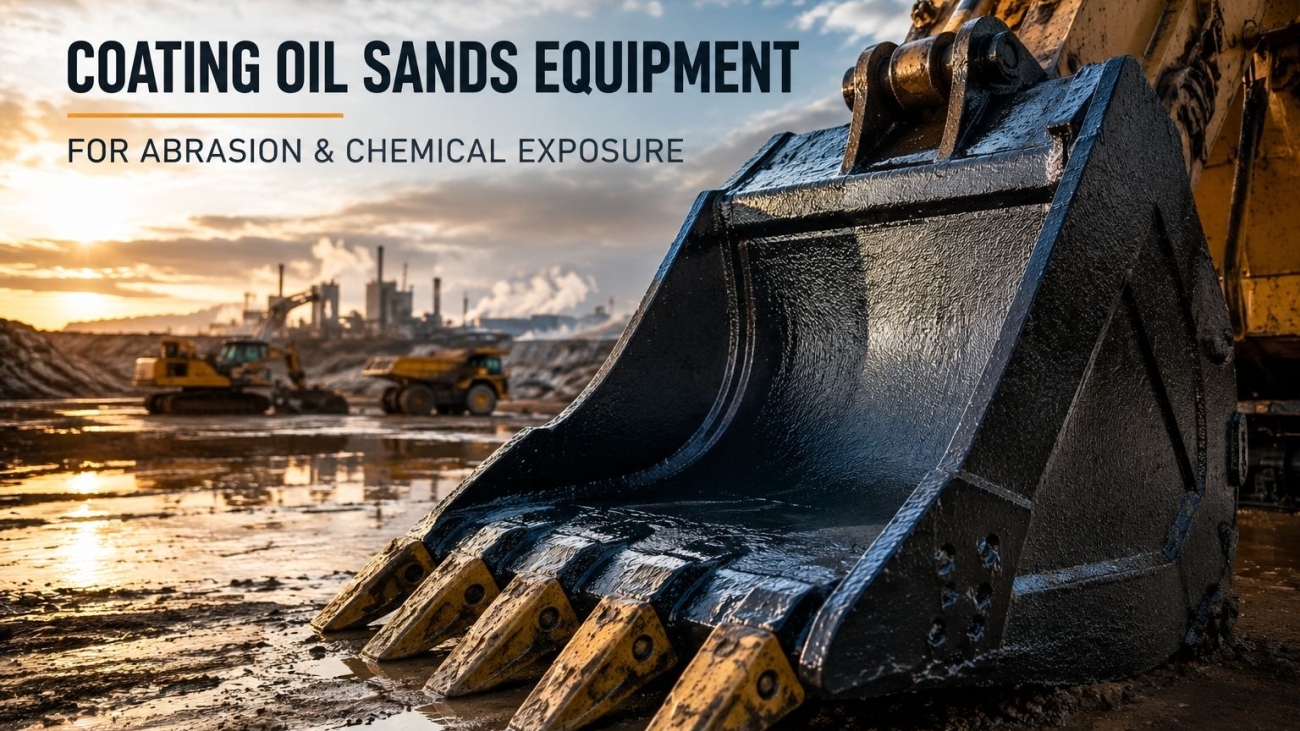
Ask anyone who’s spent time around an Alberta oil sands operation what actually kills equipment out there, and abrasion comes up before almost anything else. It’s not usually a dramatic failure. It’s the slow, grinding loss of material off a bucket lip, a pump housing, a chute liner, until one day the wall is thin enough that it just gives out. Add in the chemical exposure from bitumen, process water, and the solvents used to move it all around, and you’ve got a punishing combination that eats through unprotected steel faster than most people outside the industry would guess.
This piece looks at what’s actually driving that wear, and what coating approaches genuinely hold up against it, rather than just buying a few extra months before the next repair, because in an operation where downtime costs real money every hour, the difference between those two outcomes matters a lot more than it might on paper.
What’s Actually Wearing Equipment Down Out There
Oil sands operations move an enormous amount of abrasive material, sand-laden slurry, oil sands ore, tailings, and every ton of it is grinding against the metal surfaces it passes through or over. Bucket teeth and liners on excavators and haul trucks take the most obvious beating, but the damage doesn’t stop there. Slurry pipelines, pump casings, cyclone liners, and chute surfaces all see continuous material flow that wears them down from the inside, often invisibly, until a failure shows up as unplanned downtime rather than a scheduled repair.
Then there’s the chemical side of it. Bitumen itself is aggressive on unprotected surfaces over time, and the process involves various solvents, hot water, and caustic agents depending on the extraction method being used. A coating that handles abrasion beautifully but breaks down under that chemical exposure isn’t actually solving the problem, it’s just failing in a different, sometimes less obvious way.
Cold weather makes all of this worse, not better. A Northern Alberta winter adds thermal cycling and embrittlement risk on top of everything else, and equipment that’s already stressed by abrasion and chemical exposure has less margin to handle that added stress without cracking or spalling at the coating level.
Why Standard Coatings Often Don’t Cut It
A lot of operations start with whatever coating or lining approach is cheapest or most familiar, and that’s often a mistake that only becomes obvious after the fact. Standard paint systems offer essentially no abrasion resistance and wear through quickly under sustained slurry contact. Basic epoxy coatings hold up better but tend to be more brittle, and brittleness is a real liability on equipment that’s also dealing with impact loading and vibration, not just steady wear.
The equipment that actually survives out there long-term tends to be protected with something purpose-built for the combination of abrasion, chemical exposure, and mechanical stress this environment throws at it, not a generic industrial coating pulled off a shelf because it was on hand.
What Makes a Coating Actually Hold Up
Abrasion resistance is the obvious first requirement, but it’s worth being specific about what that actually means in practice. A coating needs enough hardness and toughness to resist the cutting and gouging action of moving abrasive slurry, without being so rigid that it cracks under the impact and flexing that heavy equipment experiences constantly. That balance between hardness and flexibility is where a lot of coating choices go wrong, either too soft and it wears through fast, or too hard and brittle and it cracks off in sheets.
Chemical resistance has to hold up against the specific exposure the equipment sees, bitumen, process water, solvents, whatever mix is relevant to that particular application, not just a generic “chemical resistant” label on a data sheet. This is exactly the kind of thing that needs to be confirmed against a manufacturer’s actual technical documentation for the specific formulation being considered, rather than assumed from the product category alone.
And then there’s the cold weather factor again. A coating that performs well at room temperature can behave very differently once it’s actually out on a pad in January. Application itself needs to happen within a workable temperature and substrate condition window, and our piece on substrate temperature and dew point for cold-weather application covers exactly why that matters, and it applies just as much to equipment coating projects scheduled through a Canadian winter as it does to any other application.
Spray-Applied Coatings for High-Wear Equipment
Spray-applied polyurea and polyurethane systems have become a common answer for exactly this kind of demanding application, and the reasons come back to the same properties that make these chemistries useful elsewhere in Canadian industry: flexibility that tracks with equipment movement and vibration instead of cracking, strong abrasion resistance, and a cure speed that matters a lot when equipment downtime is expensive.
That last point deserves more attention than it usually gets. A piece of oil sands equipment sitting idle for a coating job isn’t just sitting there, it’s a piece of very expensive machinery not moving material, and every day it’s out of service has a real cost attached. A coating system that cures in hours rather than days genuinely changes the economics of a maintenance program, especially when you’re talking about a fleet of equipment that needs periodic recoating on a rotating basis rather than everything going down at once.
Where the Coating Actually Goes
Not every surface on a piece of equipment needs the same treatment, and treating the whole machine identically is usually a waste of money in one direction or another. Bucket interiors, chute liners, and anywhere slurry directly contacts metal need the heaviest abrasion protection. Structural surfaces that see less direct material contact but more general environmental exposure, frames, exterior panels, might call for a different formulation entirely, one weighted more toward chemical and weather resistance than pure abrasion performance.
Getting this matching right, the right coating on the right surface for the right reason, is where an experienced applicator earns their keep. It’s also where a lot of coating programs quietly waste money, either over-specifying an expensive high-performance coating on a surface that didn’t need it, or under-specifying on a surface that turns out to be the one that fails first.
Building a Coating Program, Not Just a One-Off Job
Operations running significant equipment fleets tend to get more value out of thinking about coating as an ongoing program rather than a reactive repair every time something wears through. That means tracking which equipment and which surfaces are wearing fastest, scheduling recoating before a full failure forces unplanned downtime, and keeping a consistent standard across the fleet rather than whatever happened to be available at the time of the last emergency repair.
This kind of proactive approach matters more in a region already dealing with the broader infrastructure pressure that comes with Canadian climate extremes. Our look at climate pressure on Canadian infrastructure covers some of that bigger picture, and equipment protection is really just one piece of a larger pattern where getting ahead of wear and damage beats reacting to it after the fact.
Comparing Coating Approaches for Oil Sands Equipment
| Approach | Abrasion Resistance | Chemical Resistance | Flexibility | Typical Use |
|---|---|---|---|---|
| Standard paint | Poor | Limited | Low | Not recommended for high-wear surfaces |
| Basic epoxy | Moderate | Moderate | Low, more brittle | Lower-stress structural surfaces |
| Spray-applied polyurea/polyurethane | Strong | Strong, formulation-dependent | High | Buckets, liners, high-wear and high-flex surfaces |
| Replaceable wear liners (steel, ceramic) | Very strong | Not applicable | Rigid | Highest-abrasion, lower-flex applications |
Things Worth Checking Before Committing to a Coating Program
A few questions tend to separate a coating program that actually delivers from one that just adds cost without solving the underlying wear problem. Has the specific chemical exposure for this equipment actually been documented, rather than assumed from general industry practice? Is the coating being matched to the specific surface and its wear pattern, rather than applied uniformly across the whole machine? Has application been scheduled with realistic cold-weather conditions in mind, rather than assuming summer application conditions will hold true through a Canadian winter project timeline? And is there an actual tracking process for coating performance over time, so the next recoating decision is based on real wear data rather than guesswork?
Fleet vehicles supporting oil sands operations face a related, if less extreme, version of this same protection challenge from road salt and winter exposure. Our piece on protecting fleets through a Canadian winter covers that side of equipment protection, which many operations are managing alongside their heavy equipment coating programs.
Frequently Asked Questions
What’s the biggest cause of equipment failure in oil sands operations?
Abrasion from sand-laden slurry and ore contact is one of the most consistently cited causes, often compounding with chemical exposure and cold-weather stress to accelerate wear beyond what any single factor would cause alone.
Can one coating handle both abrasion and chemical exposure?
Many spray-applied polyurea and polyurethane systems are formulated to handle both, but the specific chemical compatibility needs to be confirmed against the exact substances the equipment will actually contact, not assumed from a general product category.
Does cold weather affect how long a coating lasts once applied?
Cold weather mainly affects the application process itself, proper substrate temperature and moisture conditions during coating, rather than the finished coating’s cold tolerance, provided it was applied correctly in the first place.
Is it worth coating every surface on a piece of equipment the same way?
Generally not. Different surfaces see different wear patterns and exposure types, and matching the coating formulation to the specific surface tends to deliver better value than a uniform, one-size-fits-all approach.
How often does oil sands equipment typically need recoating?
It varies significantly based on duty cycle, material handled, and original coating quality, which is exactly why tracking actual wear data matters more than following a fixed calendar schedule.
Conclusion
Oil sands equipment takes a beating that most industrial applications never come close to, and treating that abrasion and chemical exposure as an afterthought instead of a primary design consideration is how operations end up with unplanned downtime and shortened equipment life. Getting the coating matched to the actual wear pattern, the actual chemical exposure, and the actual conditions the work happens in, cold Alberta winters included, is what separates equipment that runs for years from equipment that’s constantly cycling through repair, and it’s rarely the coating budget that ends up being the expensive part of that equation.
