
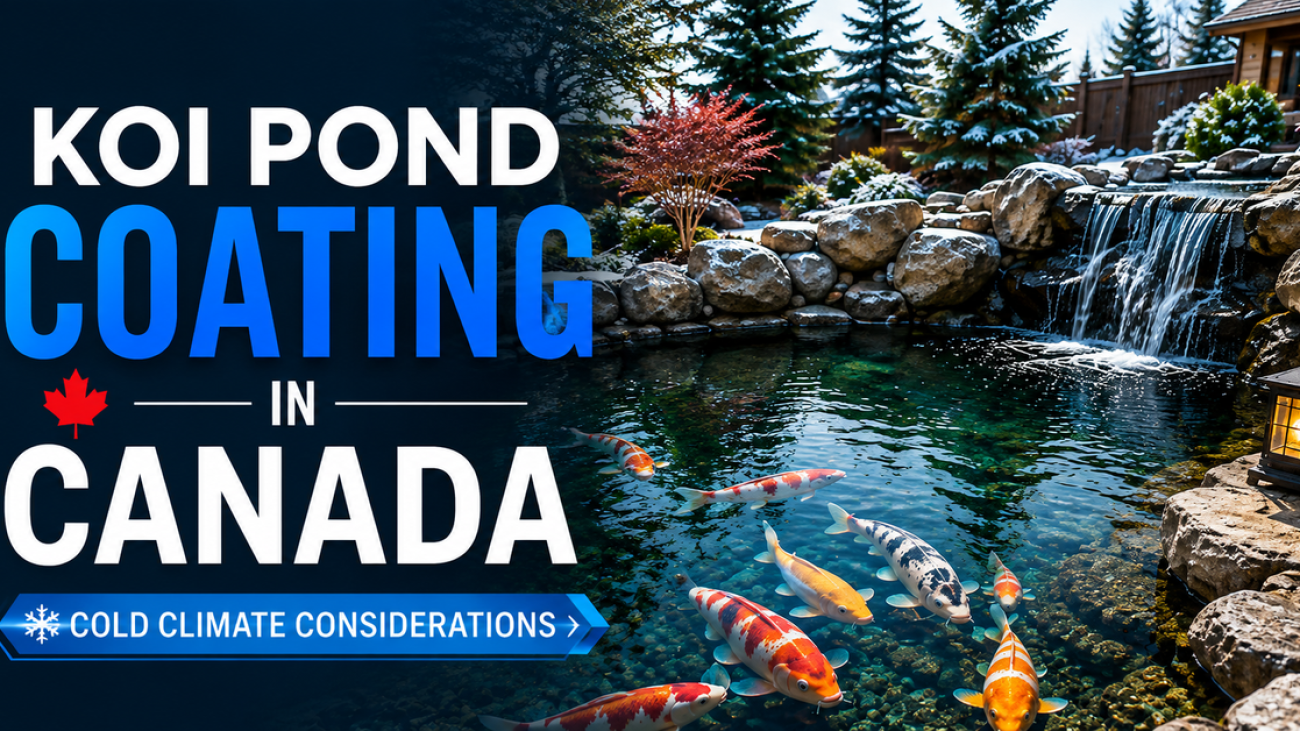
A koi pond coating that performs well in a mild climate can still fail in a Canadian backyard, and the reason usually has nothing to do with the fish. It has to do with what happens to that coating every winter when the water freezes, the ground shifts, and the whole structure goes through a stress cycle that a pond in a warmer region never sees. This guide covers what actually makes an aquatic coating fish-safe, how the main lining options compare, and what changes about that comparison once freeze-thaw cycling and Canadian winters enter the picture.
What Makes an Aquatic Coating Different From Ordinary Waterproofing
Most waterproofing coatings, the kind used on a foundation wall or a deck, spend part of the year dry and get a break from constant moisture exposure. A koi pond coating doesn’t get that break. It sits under permanent water pressure, sometimes for a decade or more without ever fully drying out, and in Canada it also has to survive that same water freezing solid around it every winter.
A handful of properties separate a genuinely aquatic-rated coating from something that just resists splashing:
- Hydrolytic stability, so the coating’s polymer structure doesn’t slowly degrade under constant water contact
- Wet adhesion, holding its bond even while the substrate underneath stays saturated
- Inertness after cure, meaning nothing, no solvent, no unreacted chemical, no plasticizer, leaches out into the water once cured
- Movement and crack tolerance, since concrete ponds shift with the ground and with freeze-thaw cycling, and a rigid coating just cracks along with it
- Geometry tolerance, because most real koi ponds have curves, shelves, and rock features rather than flat, simple walls
Spray-applied polyurea and similar high-solids elastomeric coatings tend to meet all of these requirements, largely due to how they cure. Reacting on contact rather than drying through evaporation, these systems build full film thickness in a single application and tolerate the colder, damper jobsite conditions that are simply a fact of life for a large part of the Canadian coating season.
Is an Aquatic Coating Actually Fish-Safe?
“Fish safe” and “pond safe” aren’t regulated terms anywhere, which means the label alone tells a buyer very little. What actually determines whether a coating will harm koi is whether the cured film is fully reacted and whether it contained anything mobile to begin with.
A few specific issues account for most fish-loss situations linked back to a coating:
- Residual solvent. Solvent-based pond paints carry meaningful volatile content, and filling the pond before that solvent has fully evaporated pushes it straight into the water.
- Improper mixing. A two-component coating mixed cold or mis-metered can leave unreacted material in the finished film. This is largely an application and equipment issue, which is why professional plural-component spray equipment with calibrated proportioning matters more than the product choice alone.
- Plasticizer migration. Some flexible coatings rely on an additive for stretch, and that additive can slowly leach out over the years. Polyurea’s flexibility comes from its own molecular structure, so there’s nothing extra to migrate.
- Legacy biocide pigments. Older marine coatings sometimes contained copper or zinc compounds specifically to poison fouling organisms, which is the exact opposite of what belongs in a closed pond system.
- Fresh concrete leachate. New concrete is highly alkaline and can harm fish on its own before it’s cured and stabilized, which is one reason a continuous coating that isolates the water from the concrete is genuinely useful, not just cosmetic.
Where a pond or feature is also expected to serve potable water, a verified third-party certification, most commonly NSF/ANSI 61, needs to be confirmed in writing for the exact product under consideration. That confirmation should happen before a product is specified, not assumed from general marketing claims.
How Freeze-Thaw Cycling Changes the Comparison
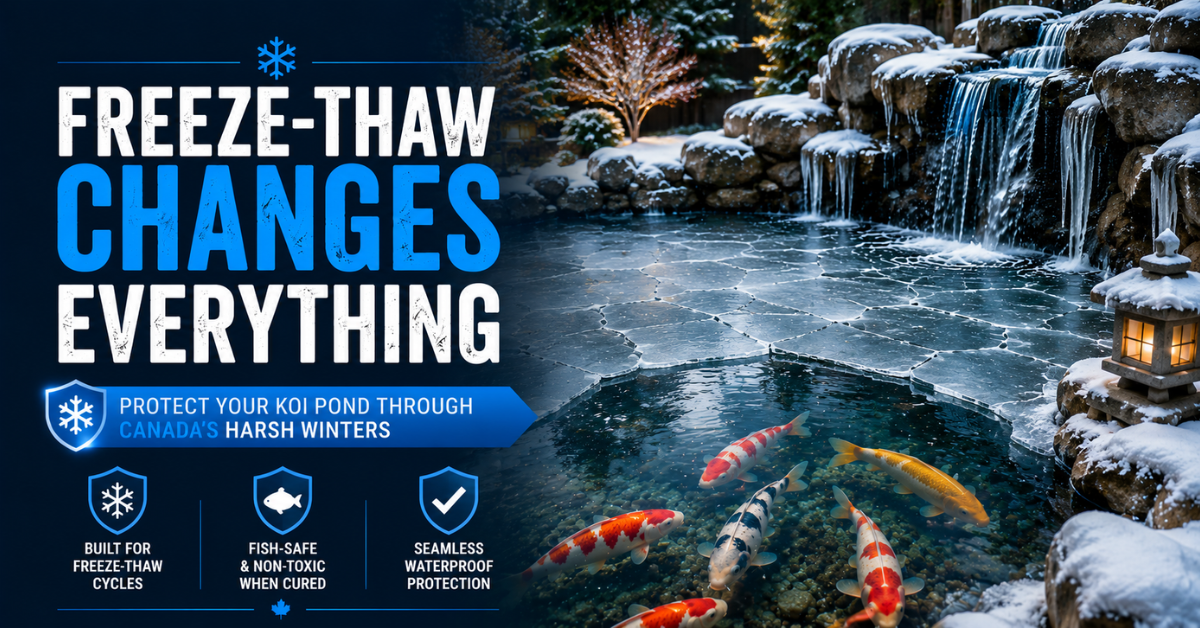
This is where the Canadian context genuinely matters. A pond that goes through repeated freezing and thawing every winter puts a coating through a stress cycle most warmer-climate installations never face. Ice forming against a coated wall exerts real pressure, and as the ground around and beneath the pond also freezes and thaws, the structure itself moves.
A rigid coating, or a coating already compromised by a poor initial bond, tends to show that stress as cracking or delamination that gets worse each winter. A flexible, well-bonded elastomeric coating is built to move with that cycle instead of fighting it, which is part of why coating flexibility deserves more weight in a Canadian koi pond decision than it might in a milder climate. Application conditions matter here too. A coating that can be applied reliably in cooler, damper weather extends the realistic construction season, which is a genuine practical advantage in a country where the outdoor coating window is shorter than in much of the United States.
Aquatic Coating Options Compared
Most pond owners are choosing between a handful of approaches: a sprayed coating, a flexible sheet liner, epoxy, a cementitious system, or basic pool paint.
| Option | Seams | Freeze-Thaw Tolerance | Fits Rockwork | Return to Service |
|---|---|---|---|---|
| Spray-applied polyurea coating | None, fully bonded | Strong, flexes with the substrate | Excellent, no sagging on vertical work | Often about a day |
| Sheet liner (EPDM/RPE) | Multiple, at seams and fittings | Fair, but seams are a weak point under repeated movement | Poor, must be pleated and folded | Immediate |
| Epoxy | Few if properly applied, but rigid | Poor, cracks with ground and ice movement | Fair, tends to sag on vertical surfaces | Several days |
| Cementitious | Depends on substrate condition | Poor to fair | Good on trowel or spray work | Weeks of curing |
| Pool paint | Thin film, minimal reserve | Very poor | Fair on smooth surfaces only | Days plus flushing |
For a simple rectangular basin without rockwork, sheet liner remains a genuinely budget-friendly choice, provided the seams are well installed. Once the design adds a waterfall, a cave, or several plumbing penetrations, and once Canadian freeze-thaw cycling is part of the picture, a seamless sprayed coating tends to hold up better over the long term.
Why Koi Ponds Are the Toughest Test, Winter or Not
Koi keeping demands more from a coating than most other pond applications, freeze-thaw aside. A serious koi collection represents years of breeding and real money, the fish live for decades, and the pond functions as a managed biological system rather than a simple hole full of water. Koi keepers also inspect and drain their ponds regularly, so problems surface quickly.
Every traditional coating option has a known failure pattern: liner develops pinhole leaks at folds, bare concrete leaches lime, fiberglass blisters at the waterline, pool paint chalks and clouds the filtration system. In a Canadian climate, freeze-thaw cycling tends to accelerate all of these failure modes rather than introduce new ones, which is part of why a properly applied, flexible, seamless coating has become the more reliable long-term option for serious koi keepers here.
The coating also has to support the pond’s biofilter rather than working against it. A surface that chalks or sheds feeds debris into the filtration system and can disrupt the nitrifying bacteria the pond depends on, and a coating marketed as antimicrobial actively works against that same bacteria colony. An inert surface is what a koi pond needs, not a hostile one.
Surface Preparation and Cold-Weather Application
Coating failures in pond work are almost always a preparation problem rather than a product problem, and in Canada, application temperature adds another layer to get right. Structural issues, cracks, spalling, exposed rebar, need to be repaired before any coating goes on. Substrate moisture needs to be tested rather than assumed, since concrete that looks dry can still hold enough internal moisture to blister a coating from underneath. And for any project running into shoulder-season weather, substrate temperature and dew point both need to be checked before spraying, since applying too close to the dew point risks trapping moisture under the new coating.
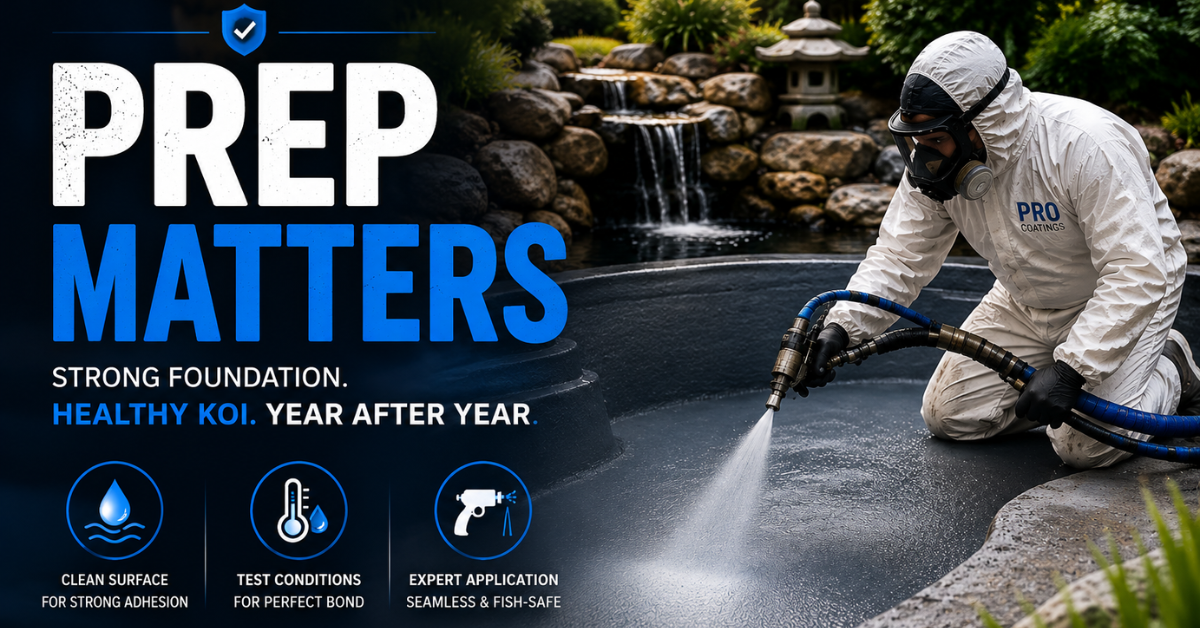
Our guide on spraying in cold weather, covering substrate temperature and dew point, goes into more depth on how to check conditions properly before a cold-season application, and the same principles apply directly to pond and water feature work, not just industrial coating jobs.
What Drives the Cost of a Koi Pond Coating in Canada
There’s no honest flat price-per-square-metre number for this kind of work, since two ponds with the same water volume can differ significantly in cost depending on geometry and access. Surface preparation is usually the largest single cost driver, particularly on a retrofit involving old cracked concrete or a failed prior coating. Rockwork, caves, and shelving can add well beyond what a simple plan-view measurement would suggest, which is why proper quotes are based on wetted surface area rather than water volume. In Canada specifically, a shorter outdoor application season can also affect scheduling and, in some cases, pricing, since contractors have a narrower window to complete exterior work before winter sets in.
The more useful comparison across quotes is lifecycle cost rather than the number at the top of the page. A coating that needs to be redone every few years, each time draining the pond through another Canadian winter cycle, tends to cost more over a couple of decades than a properly installed, flexible coating that only needs occasional spot maintenance.
Curing and First Fill
The most anxious part of any koi pond coating project is knowing when it’s safe to refill and reintroduce fish. That depends on how the coating cures. Solvent-based coatings cure by evaporation, which slows down considerably in cooler Canadian conditions and is hard to verify with confidence. A reactive, high-solids system cures chemically, often substantially complete within hours regardless of outdoor temperature, which is a real practical advantage for anyone trying to complete a pond project within a tight seasonal window.
A sensible commissioning sequence still applies regardless of cure speed: inspect the finished coating for pinholes, fill and hold for a day or two as a leak check, discard that first fill rather than keeping it, then refill and bring the biological filtration online before introducing fish gradually. For anyone considering how the same lining principles apply to buried or underground water storage rather than a surface pond, our piece on cistern liner repair and relining covers a closely related set of considerations, including the same certification requirements for potable use.
Things to Consider Before Choosing a Coating
- Does the pond’s design include rockwork, penetrations, or curves that would make a sheet liner’s seam count a long-term liability?
- How will the coating hold up through repeated freeze-thaw cycling specific to the region the pond is in?
- If the water may ever serve a potable purpose, has certification been verified in writing for the exact product being considered?
- What’s the substrate’s actual moisture condition, confirmed by testing rather than assumption?
- Is the contractor accounting for substrate temperature and dew point if the work is happening in shoulder-season weather?
For a broader look at how polyurea coatings are used across Canadian industries and climates more generally, our overview of polyurea coatings in Canada covers the regulatory and supply side of the picture in more depth.
Frequently Asked Questions
Is polyurea coating safe for koi and other fish?
A properly formulated and fully cured high-solids coating is chemically inert with nothing left to leach into the water once cured. Safety depends on the chemistry being fully reacted and correctly applied, not on what the label claims.
How does Canadian winter weather affect a koi pond coating?
Freeze-thaw cycling puts real stress on a coating through repeated ice pressure and ground movement. A flexible, well-bonded coating tolerates that movement far better than a rigid one, which is part of why coating flexibility deserves extra weight in a Canadian climate.
Can a koi pond coating be applied in cooler weather?
Some systems tolerate cooler, damper conditions better than others. Checking substrate temperature and dew point before application is essential regardless of the season, and becomes more critical as outdoor temperatures drop.
Is a sprayed coating better than a liner for a Canadian koi pond?
For a simple rectangular pond without rockwork, liner remains a reasonably cost-effective option. Once freeze-thaw cycling and more complex geometry are both part of the picture, a seamless, flexible sprayed coating tends to hold up better over the long term.
What certification matters if the pond water also needs to be potable-safe?
NSF/ANSI 61 is the relevant third-party certification for potable water contact and should be verified in writing for the specific product being used before it’s specified for that purpose.
Conclusion
A koi pond coating in Canada has to satisfy the same fish-safety requirements as anywhere else, but freeze-thaw cycling adds a genuine complication that shouldn’t be an afterthought. Flexibility, proper substrate preparation, and attention to application conditions during a shorter outdoor season all matter more here than they would in a milder climate. Choosing a coating built to move with the pond, rather than fight it, is what tends to separate a lining that holds up through a decade of Canadian winters from one that needs to be redone after a few.
