
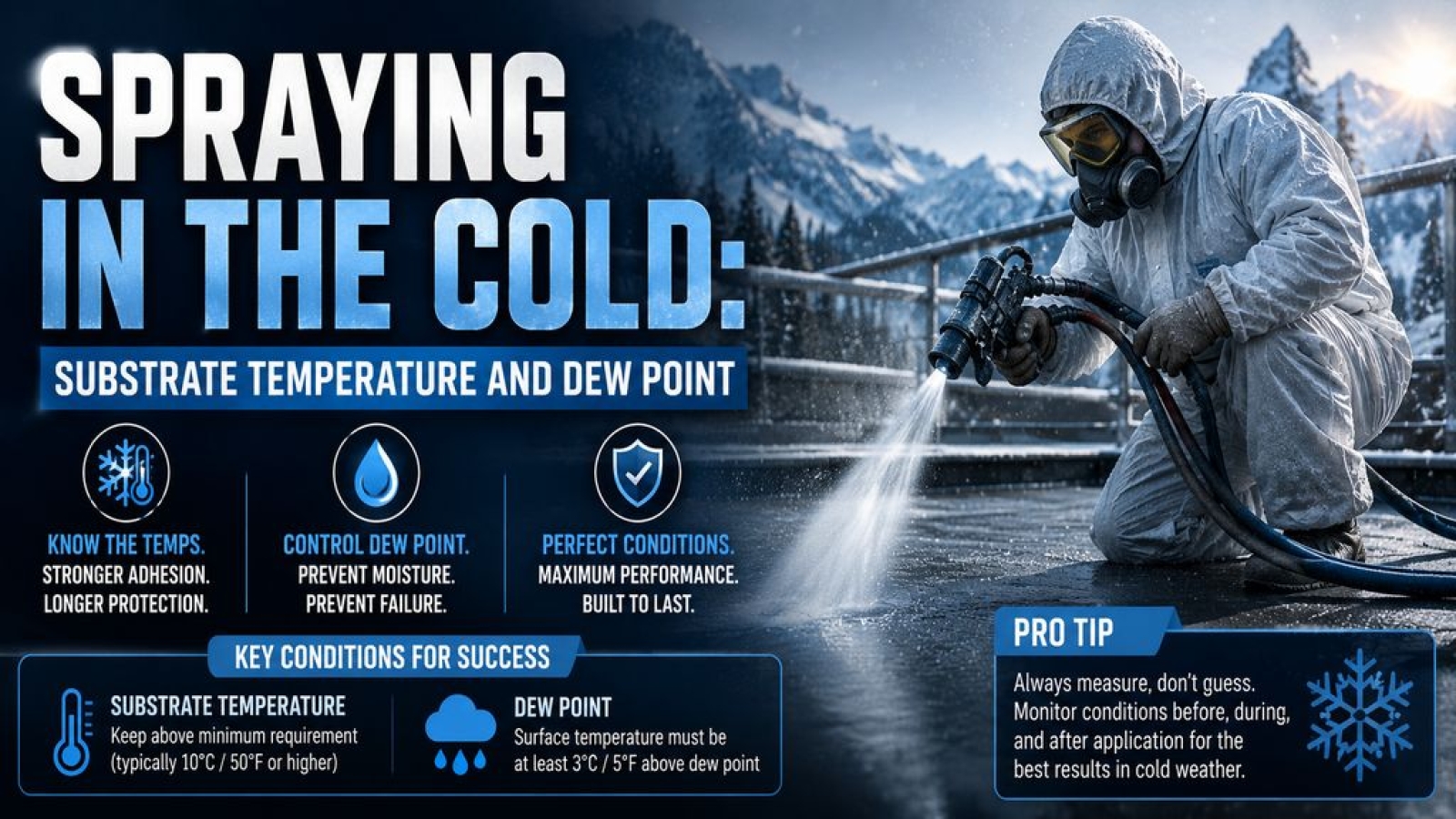
A Canadian winter does not just make a jobsite colder. It changes whether a coating will actually bond to what it is sprayed onto. Two numbers decide that outcome more than any other factor: the temperature of the substrate itself, and how close that temperature sits to the dew point. Get either one wrong and the result can be a coating that looks fine on the day it goes on and fails months later through adhesion loss, blistering, or pinholing.
This guide walks through what substrate temperature and dew point actually mean for a cold-weather application, how to check both before spraying, and what tends to go wrong when they are ignored. It is written for applicators and site supervisors working through a Canadian winter, not as a substitute for the specific technical data sheet of whatever product is being used.
Understanding the Basics
Every spray-applied coating needs the substrate it is going onto to be within a workable temperature and moisture range. In summer, that range is usually easy to hit without much thought. In a Canadian winter, hitting it takes deliberate planning, because ambient air temperature, substrate temperature, and moisture conditions can all be different from each other at the same jobsite on the same day.
Substrate temperature and dew point are the two measurements that matter most. Air temperature is what most people notice first, but it is often the least useful number for deciding whether conditions are safe to spray.
What Substrate Temperature Actually Measures
Substrate temperature is the actual surface temperature of whatever is being coated, measured with a surface thermometer rather than estimated from the air temperature. A steel tank sitting in direct sun can read several degrees warmer than the surrounding air, while a shaded concrete pad or an unheated interior slab can sit noticeably colder than the air around it, especially overnight or early in the morning.
This matters because the chemical reaction that cures a coating happens at the surface, not in the surrounding air. A substrate that is too cold slows that reaction, can affect adhesion, and in some cases prevents the coating from curing properly at all.
Dew Point Explained
Dew point is the temperature at which air can no longer hold its moisture as vapour, causing that moisture to condense onto surfaces instead. When a substrate’s temperature drops to or below the dew point, moisture forms on it, whether that is visible frost, a light film, or condensation too thin to easily see.
Dew point is not the same as humidity, and it changes with both temperature and relative humidity. On a Canadian jobsite, dew point can shift meaningfully between early morning and midday, particularly during shoulder seasons when temperature swings are larger.
Why the Gap Between the Two Matters
If a substrate’s temperature is too close to the dew point, moisture can condense onto the surface during or shortly after application, even if the surface looked dry when the crew started spraying. That trapped moisture can interfere with adhesion and lead to problems that do not show up immediately: blistering, pinholing, or delamination that appears weeks or months after the job was finished and signed off.
A commonly referenced industry guideline is keeping substrate temperature a minimum of a few degrees above dew point before spraying, though the specific margin, and whether it is expressed in Celsius or as a percentage buffer, depends on the coating manufacturer’s technical data sheet for the exact product being used. Following the TDS for the specific product on the job takes priority over a general rule of thumb.
How to Check Conditions Before Spraying
A proper pre-application check on a cold-weather job typically includes:
- Measuring substrate temperature directly with a surface thermometer, at multiple points if the structure is large or partially shaded
- Measuring ambient air temperature and relative humidity
- Calculating or reading dew point from a psychrometric chart or a dew point calculator built into many jobsite weather meters
- Confirming the gap between substrate temperature and dew point meets the product’s technical data sheet requirement
- Rechecking conditions if there is a meaningful time gap between the check and the actual spraying, since winter conditions can shift quickly, particularly around sunrise
Skipping any of these steps because “it looks fine” is one of the more preventable causes of coating failure on Canadian jobs.
Cold-Weather Equipment and Material Adjustments
Spraying in cold conditions usually requires more than just checking the numbers and proceeding. Common adjustments include:
- Preheating the substrate using heaters, heat blankets, or enclosures to bring surface temperature into a workable range
- Insulated or heated enclosures around the work area to stabilize both air and substrate temperature during application
- Heated hose lines and proportioning equipment to keep material viscosity and reactivity consistent, since cold material behaves differently than material at room temperature
- Cold-weather-rated formulations, where available, designed to perform in a lower temperature range than a standard formulation
None of these adjustments replace checking substrate temperature and dew point. They extend the window in which those numbers can be met, not a substitute for meeting them.
Application Conditions at a Glance
| Condition | Risk Level | What It Means for the Crew |
|---|---|---|
| Substrate well above dew point, stable temperature | Low | Standard application procedure applies |
| Substrate close to dew point, rising temperature trend | Moderate | Delay until the gap widens, recheck before starting |
| Substrate at or below dew point | High | Do not spray, moisture will likely condense on or under the coating |
| Rapidly dropping temperature during application | High | Stop and reassess, conditions can move below the safe threshold mid-job |
| Enclosed, heated, and monitored environment | Low | Most reliable setup for winter application in Canada |
Common Mistakes in Winter Application
- Relying on air temperature alone instead of measuring the substrate directly
- Treating a morning reading as valid for the whole day without rechecking as conditions shift
- Assuming a visually dry surface means no moisture risk, when frost or condensation can be present without being obvious
- Pushing ahead on a schedule despite a marginal reading, on the assumption that “it usually turns out fine”
- Not accounting for shaded or partially heated sections of a larger structure that may sit at a different temperature than the rest of the surface
Best Practices for Canadian Winter Jobsites
Given how much climate variability is already putting pressure on Canadian infrastructure, getting cold-weather application right the first time matters more than it used to. Building a genuine buffer into scheduling, rather than planning around the minimum acceptable temperature gap, gives a crew room to delay without falling behind if conditions run colder than forecast. For a broader look at how cold-climate application fits into polyurea use across the country, see our overview of polyurea coatings in Canada.
Maintenance and Inspection After a Cold-Weather Application
Coatings applied in marginal winter conditions are worth a closer follow-up inspection than a summer application, since moisture-related problems can take weeks or months to appear. Checking for early signs of blistering, soft spots, or edge lifting during the first thaw cycle after a winter application is a reasonable practice, particularly on larger or higher-value structures.
Frequently Asked Questions
What is the difference between air temperature and substrate temperature?
Air temperature measures the surrounding atmosphere, while substrate temperature measures the actual surface being coated. The two can differ significantly, especially with direct sun, shade, or unheated interior surfaces, and substrate temperature is what actually governs cure and adhesion.
What happens if you spray too close to the dew point?
Moisture can condense on or under the coating, which risks adhesion problems and issues like blistering or pinholing that may not appear until well after the job is finished.
Can polyurea be applied in winter in Canada?
Yes, with the right preparation. Preheating, enclosures, heated equipment, and cold-weather-rated materials all extend the window in which application is safe, but the substrate temperature and dew point still need to be checked and met.
How often should conditions be rechecked during a job?
Regularly, especially early in the day or during any noticeable weather shift. Conditions that were acceptable at the start of a shift can change within a few hours, particularly around sunrise or with an incoming weather system.
Is there a standard minimum gap between substrate temperature and dew point?
General industry guidance points to keeping substrate temperature several degrees above dew point, but the specific number should come from the technical data sheet of the exact product being applied rather than a generic rule.
Conclusion
Cold weather does not rule out a quality polyurea application in Canada, but it does raise the cost of skipping the basics. Substrate temperature and dew point are not optional checks to speed past on a cold morning. They are the two numbers that determine whether a coating bonds properly or fails quietly months down the line. Building the time for proper checks, and the equipment to extend the safe application window, into a winter project plan is what separates a coating that holds up through freeze-thaw season from one that needs to be redone.
