
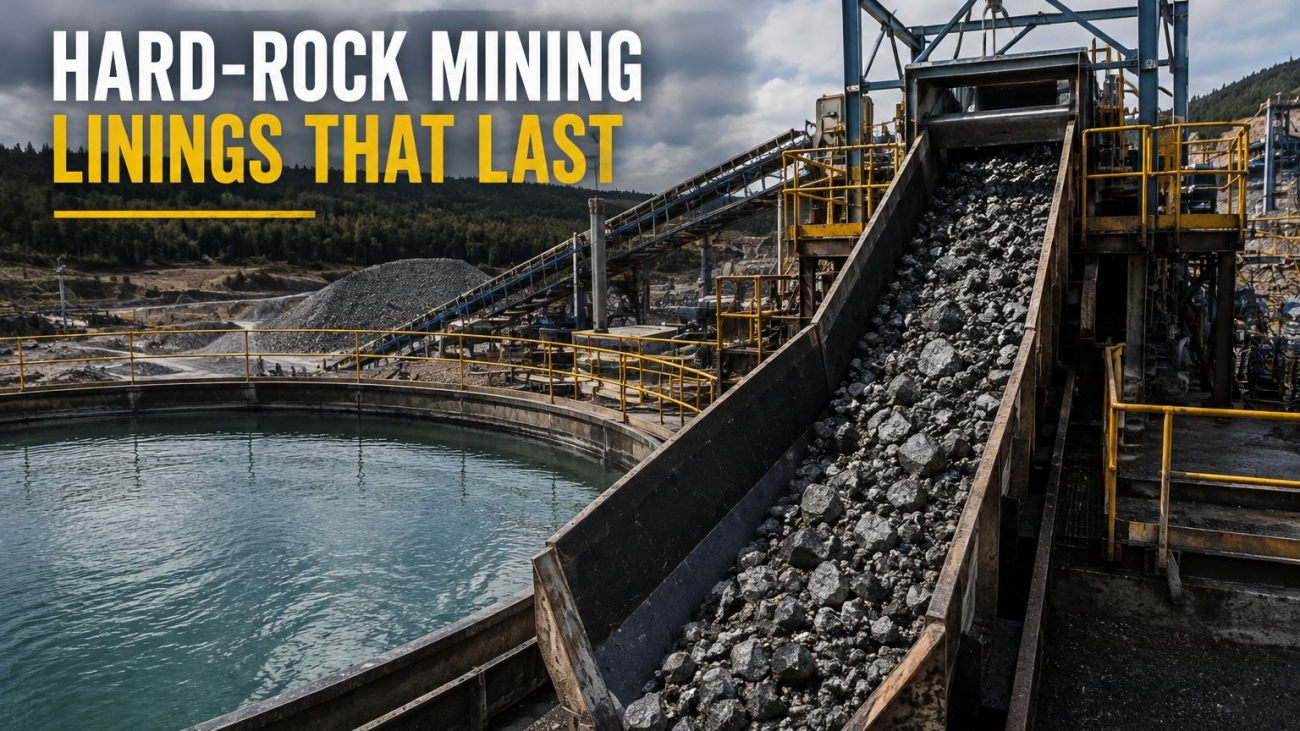
Walk through a Canadian hard-rock mine and you’ll find three very different environments demanding three very different kinds of protection, often within a few hundred metres of each other. A sump is fighting standing water and slurry. A chute is fighting the relentless abrasion of ore sliding and crashing through it hour after hour. A leach circuit is fighting chemistry aggressive enough to dissolve metal out of rock on purpose, which tells you something about what it does to unprotected steel or concrete it happens to touch along the way. Treating all three the same, or assuming whatever coating worked on one will automatically work on another, is how a mine ends up with a lining program that looks consistent on paper but fails inconsistently in the field.
This piece breaks down what each of these three environments actually demands, and where coating choices tend to succeed or fall short in Canadian mining operations specifically.
Sumps: Fighting Water, Slurry, and Constant Cycling
A mine sump collects water and slurry from operations happening above it, pumping station intakes, drainage from underground workings, runoff from processing areas, and it does this continuously, cycling between full and empty depending on operational conditions. That constant wet-dry cycling is harder on a lining than sustained submersion would be, since the transition zone, where the liner is repeatedly wetted and exposed, tends to see accelerated wear compared to a surface that’s simply underwater all the time.
Sumps in a Canadian operation deal with an added complication most warmer-climate mines don’t: freeze-thaw cycling in any exposed or partially exposed sump, particularly ones with seasonal access or intermittent heating. A lining that handles constant wetting well in a temperate climate can behave differently once it’s also dealing with ice formation and thaw cycles layered on top of that wear pattern.
Concrete sumps without a proper liner are vulnerable to the same kind of chemical attack that affects other underground concrete structures, and standing water with dissolved minerals or process chemicals can be more aggressive than clean water alone. A flexible, bonded coating that seals the concrete from that exposure while tolerating the constant wet-dry and freeze-thaw cycling tends to outperform a rigid or unsealed alternative by a wide margin over the sump’s service life.
Chutes: Where Abrasion Does Most of the Damage
Ore chutes see a different kind of punishment entirely. Material sliding, tumbling, and impacting through a chute wears away at the surface through sheer mechanical abrasion, and depending on the ore’s hardness and the chute’s geometry, that wear can be surprisingly fast on unprotected steel. A poorly protected chute can develop wear-through holes within a relatively short operational period, and every unplanned shutdown to patch or replace a worn-through section costs more in lost production than most maintenance budgets account for upfront.
The coating question for chutes comes down to balancing hardness against flexibility, the same tension that shows up in other high-abrasion mining applications. Too soft, and the lining wears through quickly under sustained ore contact. Too hard and rigid, and it can crack or spall off under the impact loading that chutes experience, particularly with larger or harder ore fragments. A properly formulated spray-applied lining that has enough abrasion resistance to handle sustained contact while staying flexible enough to absorb impact without cracking tends to be the sweet spot operations are actually looking for, even if they don’t always describe it that specifically when a chute lining conversation comes up.
Our piece on coating oil sands equipment for abrasion and chemical exposure covers a closely related version of this same hardness-versus-flexibility balance, since bucket liners and chute liners are solving a similar mechanical problem even though the industries and specific chemical exposures differ.
Leach Circuits: A Different Kind of Aggressive
Leach circuits, used in processes like heap leaching or vat leaching to extract metals from ore using chemical solutions, expose infrastructure to a genuinely aggressive chemical environment that neither sumps nor chutes typically face. Depending on the specific process, that might mean acidic solutions, cyanide-based solutions, or other reagents chosen specifically because they’re effective at dissolving target metals out of rock, which should tell you everything you need to know about what they’ll do to an unprotected tank, pad, or pipe.
This is an area where chemical compatibility can’t be treated as a general assumption. The exact reagent chemistry, concentration, and operating temperature for a specific leach circuit all affect which lining materials will actually hold up, and this needs to be confirmed against a manufacturer’s actual technical documentation for the specific formulation under consideration, not assumed from a general “chemical resistant” product description. A lining that performs well against one leach chemistry can fail relatively quickly against a different one, even within what looks like a similar mining process from the outside.
Leach pad liners specifically also carry an environmental containment responsibility that goes beyond just protecting the underlying structure, since a breach in this kind of liner risks releasing leach solution into the surrounding environment. That combination of aggressive chemistry and environmental consequence is why leach circuit lining specification tends to get more scrutiny, and rightly so, than a lot of other mining coating decisions.
Why Canadian Conditions Change the Calculation
Every one of these three applications gets a layer of added difficulty from operating in Canada specifically. Cold temperatures affect application conditions, curing behaviour, and the finished coating’s flexibility at low temperatures, all factors that a mine operating in a warmer climate simply doesn’t have to think about to the same degree. Our guide on substrate temperature and dew point for cold-weather application covers why getting these conditions right during application matters just as much for mining infrastructure as it does for any other cold-climate coating project, and skipping that consideration is one of the more common reasons a lining project underperforms despite using a genuinely good material.
Remote site logistics matter too, in a way that’s easy to underestimate from an office. A mine site hours from the nearest supply depot can’t always wait for a reapplication or a quick fix the way an urban facility might, which puts more weight on getting the material and application right the first time rather than treating it as something that can be easily corrected later.
Comparing Lining Needs Across the Three Applications
| Application | Primary Threat | Key Lining Property Needed | Added Canadian Factor |
|---|---|---|---|
| Sumps | Wet-dry cycling, dissolved mineral/chemical exposure | Flexible, bonded, seals concrete from moisture | Freeze-thaw cycling on exposed or seasonal sumps |
| Chutes | Mechanical abrasion, impact loading | Balance of hardness and flexibility | Cold application conditions during scheduled maintenance windows |
| Leach circuits | Aggressive process chemistry | Verified chemical compatibility for the specific reagent | Cold temperature effects on cure and flexibility |
Things Worth Checking Before Specifying a Lining
A few questions tend to separate a lining program built on real assessment from one built on habit or convenience. Has the specific application, sump, chute, or leach circuit, actually been evaluated for its own exposure profile, rather than defaulting to whatever lining the operation used somewhere else on site? For leach circuits specifically, has chemical compatibility been confirmed against the exact reagent chemistry and concentration in use, not just a general product category? Has application been scheduled with realistic cold-weather site conditions in mind, particularly for outdoor or seasonally accessible infrastructure? And is there a plan for periodic inspection, since even a well-chosen lining benefits from being checked rather than assumed to be performing indefinitely once installed?
The broader pattern of Canadian infrastructure facing increased climate-related strain applies to mining operations as much as any other sector. Our look at climate pressure on Canadian infrastructure covers some of that wider context, and mining lining decisions are really just one specific application of a much broader need to plan for tougher operating conditions rather than assuming historical norms will hold.
Building a Lining Program Rather Than Reacting Site by Site
Mines running multiple sumps, chutes, and process areas tend to get better long-term results from treating lining as a coordinated program, tracking which areas wear fastest, scheduling relining before a failure forces unplanned downtime, and matching material choice to each application’s actual demands rather than standardizing on one product across every use case regardless of fit. Our overview of polyurea coatings in Canada touches on this broader application range, which includes exactly this kind of industrial and resource-sector use alongside other Canadian applications.
Frequently Asked Questions
Can the same coating be used for sumps, chutes, and leach circuits?
Sometimes a similar base chemistry works across applications, but the specific formulation and any topcoat or chemical resistance additive needs to be matched to each application’s actual exposure, since a chute-optimized abrasion coating and a leach-circuit-optimized chemical resistant coating aren’t necessarily interchangeable.
Why does chute lining fail faster than expected sometimes?
Underestimating the abrasion severity of the specific ore being handled, or choosing a lining that’s either too soft to resist wear or too rigid to absorb impact, are the most common reasons a chute lining underperforms relative to expectations.
Is chemical compatibility testing necessary for every leach circuit application?
Given how much reagent chemistry, concentration, and temperature vary between operations, confirming compatibility against the specific conditions of a given leach circuit is a reasonable precaution rather than an unnecessary extra step.
Does cold weather affect how well a mining lining performs once installed?
Cold weather primarily affects the application process itself, proper substrate conditions during coating, rather than a properly cured lining’s cold tolerance afterward, which is why getting application conditions right matters so much in a Canadian operating environment.
How often should mining linings be inspected?
It depends on the specific application’s wear rate and criticality, but chutes and other high-abrasion areas generally warrant more frequent inspection than lower-wear applications like properly lined sumps, given how quickly abrasion damage can progress once a lining starts to fail.
Conclusion
Sumps, chutes, and leach circuits each demand something different from a lining system, and a mining operation that treats them as interchangeable coating decisions is setting itself up for premature failures in at least one of the three. Matching the lining to the actual threat, wet-dry cycling and mild chemical exposure in sumps, abrasion and impact in chutes, aggressive process chemistry in leach circuits, while accounting for what a Canadian winter adds on top of all three, is what separates a lining program that actually holds up from one that’s constantly playing catch-up on unplanned repairs.
