
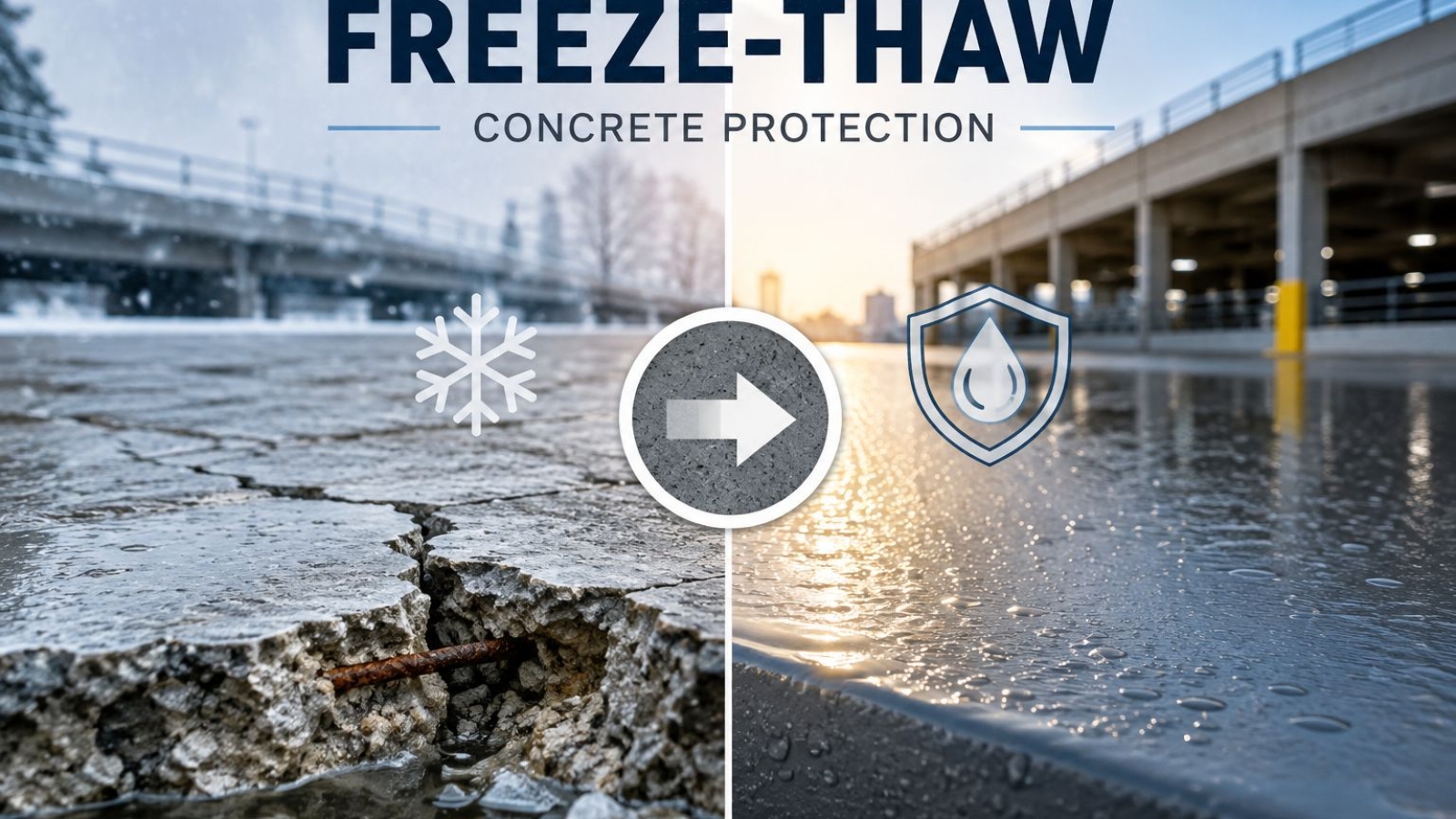
Freeze-thaw concrete protection is a year-round concern for anyone maintaining infrastructure across Canadian winters, but the damage itself is done in a narrow window: every time saturated concrete freezes and thaws, the structure loses a little more integrity. Parking structures, bridge decks, sidewalks, loading docks, and municipal water infrastructure all face repeated freeze-thaw cycling combined, in many cases, with de-icing salt exposure that makes the damage worse. Coatings are one of the more effective tools for interrupting that cycle, but only when the mechanism behind freeze-thaw damage, and how a coating actually addresses it, is properly understood.
How Freeze-Thaw Damage Actually Works
Concrete is a porous material, and those pores hold water when the surface is saturated by rain, snowmelt, or standing moisture. When temperatures drop below freezing, that trapped water expands as it turns to ice, roughly nine percent by volume. In a saturated pore structure with nowhere for that expansion to go, the resulting internal pressure cracks the concrete at a microscopic level. Repeat that cycle enough times across a Canadian winter, and those microscopic cracks grow into visible scaling, spalling, and eventually structural deterioration.
De-icing salts make the problem worse in two ways. They lower the freezing point of surface water, which increases the number of freeze-thaw cycles a structure experiences over a season as temperatures hover near the threshold repeatedly. They also draw additional moisture into the concrete through osmotic pressure, increasing saturation levels right when the material can least afford it. This combination is a major reason freeze-thaw deterioration is a bigger concern on Canadian roads, bridges, and parking structures than in climates without regular road salt use.
Air-entrained concrete, which incorporates microscopic air bubbles into the mix during batching, is designed to give that expanding water somewhere to go, reducing internal pressure and freeze-thaw damage. It’s a standard specification for concrete exposed to Canadian winters, but even properly air-entrained concrete benefits from reduced water saturation at the surface, which is where coatings come in.
The rate of deterioration also depends on how many freeze-thaw cycles a structure actually experiences in a season, not just how cold it gets. A location with temperatures that hover repeatedly around the freezing point, common across much of southern and coastal Canada, can put a structure through many more freeze-thaw cycles in a winter than a consistently cold climate that freezes once and stays frozen. That distinction matters when assessing risk, since a structure in a milder, more variable climate can face more cumulative freeze-thaw stress over a season than one in a colder but more stable environment.
Freeze-Thaw Concrete Protection: How Coatings Interrupt the Cycle
The core mechanism behind freeze-thaw concrete protection through coatings is straightforward: reduce how much water gets into the pore structure in the first place, and there’s less water available to freeze, expand, and crack the substrate. A properly applied, low-permeability coating acts as a barrier between the concrete surface and the moisture that would otherwise saturate it during wet, cold conditions.
Beyond keeping water out, the coating’s own flexibility matters. A rigid coating that can’t accommodate the concrete’s minor thermal movement and any residual freeze-thaw expansion is prone to cracking itself, which then creates new pathways for water to reach the substrate. A flexible, seamless membrane that moves with the substrate rather than fighting it holds up better across repeated seasonal cycling, particularly at joints, transitions, and any area with existing minor cracking that the coating needs to bridge rather than simply cover.
Seam quality matters as much as the coating material itself. A coating with seams, laps, or gaps gives water a path around the barrier rather than through it, which is part of why seamless, fully bonded systems tend to perform better in freeze-thaw applications than products that rely on overlapping sheets or panels.
Comparison of Coating Approaches
| Factor | Polyurea | Standard Epoxy | Penetrating Sealer |
|---|---|---|---|
| Moisture barrier | Strong, low permeability | Strong when properly cured | Reduces absorption, does not form a full membrane |
| Flexibility across freeze-thaw cycling | High | Lower, more rigid | Not applicable, does not form a film |
| Cold-weather application tolerance | Formulation-dependent, some systems suited to lower temperatures | Generally more sensitive to low temperature and moisture during cure | Often more tolerant of cooler application windows |
| Seam-free coverage | Yes, sprayed as a continuous membrane | Yes, when properly applied | Yes, penetrates rather than forms a surface film |
| Typical use | Parking structures, bridge decks, high-exposure areas | Interior or less exposed concrete | Lower-traffic surfaces, supplemental protection |
Best Use Cases
Coating-based freeze-thaw concrete protection tends to deliver the most value on structures with both significant freeze-thaw exposure and de-icing salt contact: parking garages, bridge decks and approaches, loading docks, and municipal infrastructure in regions with a long winter season. These are also the structures where the cost of neglecting freeze-thaw protection tends to be highest, since structural concrete repair on a bridge deck or parking structure is considerably more expensive than a protective coating maintenance cycle.
For a broader look at how polyurea coatings are specified, supplied, and standardized across Canadian projects generally, our overview on polyurea coatings in Canada covers the standards and supply landscape applicators and specifiers work within. Application timing and conditions matter just as much as the coating choice itself in a cold climate, and our guide on spraying in the cold: substrate temperature and dew point covers the specific conditions that determine whether a cold-weather application will actually bond and cure properly.
Application Planning
Address existing moisture and damage before coating. A coating applied over concrete that’s already saturated or actively spalling won’t reverse existing damage. Repair and moisture assessment need to happen first, with the coating serving to prevent further deterioration going forward rather than fixing what’s already occurred.
Confirm the coating’s cold-weather application range. Not every coating system can be applied in the temperature and humidity conditions common during a Canadian shoulder-season application window. Confirm the manufacturer’s minimum application temperature and substrate conditions before scheduling cold-weather work, and don’t assume a system rated for one climate performs the same in another without checking its specific documentation.
Plan around de-icing salt exposure specifically, not just general moisture. A structure exposed to heavy road salt application needs a system evaluated for that specific exposure, since salt-laden water behaves differently than plain moisture in terms of penetration and the osmotic pressure it creates within the substrate.
Detail joints and transitions carefully. Expansion joints, drains, and any area where the coating meets a different material are common weak points in freeze-thaw protection. These areas deserve as much attention during installation as the broad field area of the coating.
Get the coverage rate from the manufacturer’s technical data sheet in the units you’re specifying against. Many coating products are formulated and labelled by manufacturers using imperial units, and Canadian specification documents typically call for litres per square metre and millimetre film thickness. Confirm coverage in the correct units for your project rather than converting on the fly, since rounding errors in an unofficial conversion can lead to under-application.
Coordinate the project timeline around the seasonal window. Many freeze-thaw protection projects need to be completed before winter sets in, which creates a narrower application window than a project without seasonal constraints. Planning substrate repair, moisture testing, and coating application with enough lead time before the first hard freeze avoids the temptation to rush work into marginal conditions late in the season.
Common Mistakes in Freeze-Thaw Coating Projects
Coating over concrete that hasn’t been properly assessed for existing damage. A coating applied over concrete with unaddressed micro-cracking or high internal moisture content is starting from a compromised position. A proper substrate assessment, including moisture testing, should come before any coating decision, not after.
Choosing a coating based on summer performance data alone. A product with excellent moisture resistance and durability in warm-weather testing doesn’t automatically perform the same way through repeated freeze-thaw cycling. Cold-climate performance and low-temperature flexibility deserve specific attention when the structure will face a full Canadian winter.
Underestimating de-icing salt exposure on a project. Structures near roadways, ramps, or areas with heavy winter maintenance salt application face a different exposure profile than a similar structure without that traffic. Specifying a coating without factoring in the actual salt exposure the structure will see is a common gap between design intent and real-world performance.
Applying in marginal weather conditions to keep a project on schedule. Pushing an application into conditions below a coating’s minimum temperature threshold, or with dew point too close to surface temperature, risks a compromised bond that may not show up as a visible problem until the following winter, once freeze-thaw cycling has had a chance to find the weak point.
Neglecting joint and drain detailing in favour of the main field area. It’s easy to focus coating quality control on the broad, visible surface area and treat joints, drains, and transitions as an afterthought. These details are disproportionately where freeze-thaw related coating failures actually originate.
Maintenance
Coated concrete still benefits from a routine inspection schedule, particularly heading into and coming out of winter. Checking for coating wear at high-traffic areas, joint and transition integrity, and any signs of moisture intrusion at the coating edge lets a facility address small problems before a full winter season of freeze-thaw cycling turns them into larger ones. Touch-up or recoating high-wear zones on a schedule, rather than waiting for visible failure, is generally more cost-effective than reactive repair once freeze-thaw damage has already progressed into the substrate.
Frequently Asked Questions
Can a coating completely stop freeze-thaw damage?
A properly applied coating significantly reduces water saturation in the pore structure, which is the primary driver of freeze-thaw damage, but it works alongside good concrete mix design, drainage, and maintenance rather than replacing them.
Does freeze-thaw protection matter less on air-entrained concrete?
Air entrainment reduces freeze-thaw risk by giving trapped water room to expand, but it doesn’t eliminate the value of reducing surface water saturation in the first place, particularly on structures with heavy salt exposure.
Can coatings be applied in cold Canadian winter conditions?
Some systems are formulated for cold-weather application, but the specific temperature and substrate conditions required vary by product. This needs to be confirmed against the manufacturer’s technical data sheet rather than assumed.
Is freeze-thaw protection only a concern for outdoor structures?
Unheated or partially enclosed structures like parking garages face significant freeze-thaw exposure even though they’re technically indoors, since temperatures inside can still swing below freezing repeatedly through the winter.
How often should a freeze-thaw protective coating be inspected?
A seasonal inspection schedule, particularly before and after winter, helps catch wear or damage before repeated freeze-thaw cycles have a chance to compound the problem.
Do bridge decks need a different approach than parking structures?
Both face similar freeze-thaw and de-icing salt exposure, but bridge decks typically see additional considerations around traffic loading, expansion joint movement, and structural inspection requirements that should factor into the coating and detailing plan alongside freeze-thaw protection itself.
Conclusion
Freeze-thaw concrete protection comes down to limiting how much water reaches the pore structure before it has a chance to freeze, expand, and crack the substrate from the inside. Coatings that form a flexible, seamless, low-permeability barrier address that mechanism directly, particularly on structures facing both freeze-thaw cycling and de-icing salt exposure. Getting there requires more than picking a product off a data sheet: existing moisture and damage need to be addressed first, the coating needs to be rated for the actual application conditions, and joints and transitions need the same careful attention as the main field area. Done properly, a coating system extends the service life of concrete infrastructure that would otherwise face a slow, cycle-by-cycle breakdown every Canadian winter.